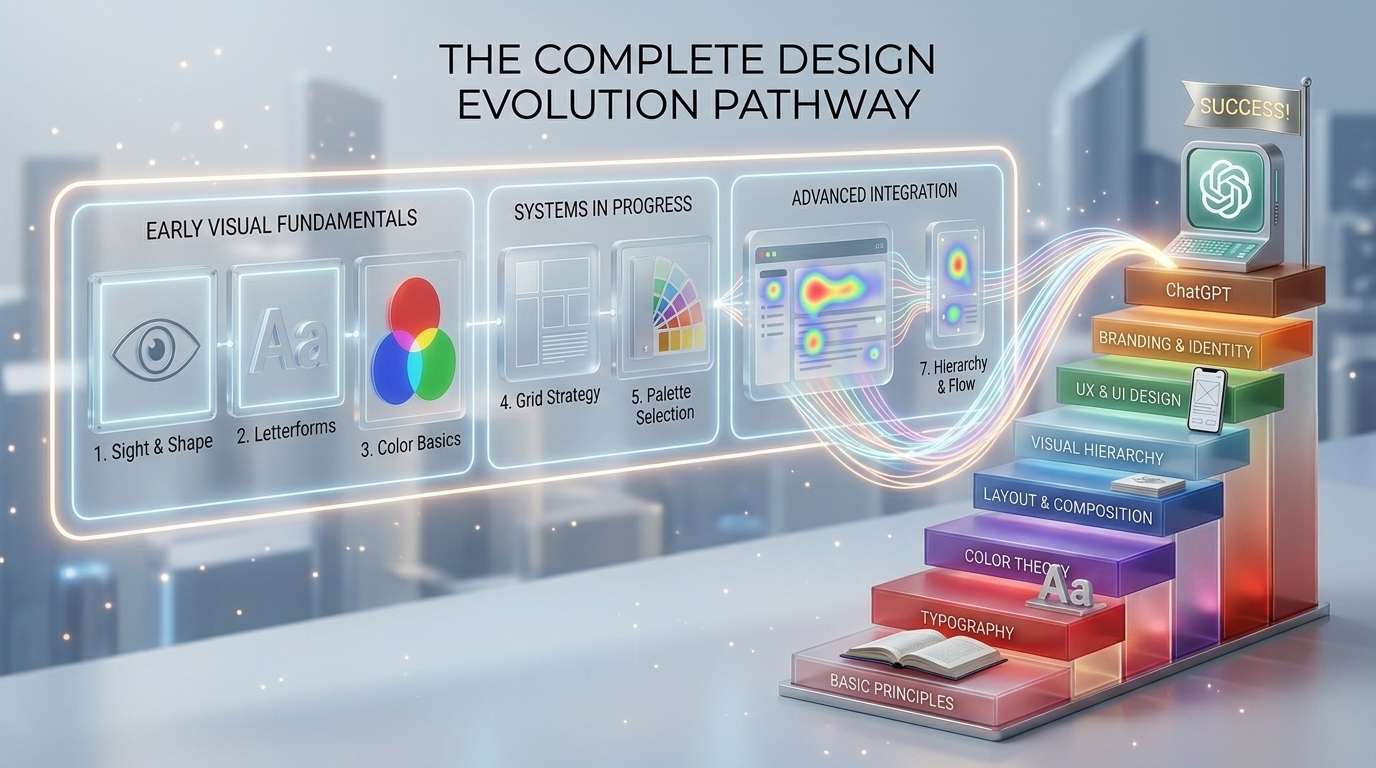
The Shortcut New Designers Love
| 4 minutes read
Jumping Straight to ChatGPT to Build the UI
A pattern is emerging among new designers.
Skip the research.
Skip the theory.
Skip the messy middle.
Go straight to ChatGPT and ask it to generate a UI.
And to be fair, the result often looks decent. Clean layouts. Balanced spacing. Familiar component patterns. At first glance, it feels like the work of a competent designer. The problem appears later, when the interface meets real users.
Design is not the arrangement of rectangles on a screen. It’s the reasoning behind why those rectangles exist. It’s understanding hierarchy, decision friction, cognitive load, and behavioral intent. Without that foundation, a UI might look correct while quietly solving the wrong problem. This is the same dynamic we see whenever tools outrun understanding, a tension explored in why you should not rely on AI alone.
Generative tools are extremely good at reproducing patterns they’ve already seen. They know what modern dashboards look like. They know the typical structure of a login flow. They know how cards, modals, and navigation bars are usually arranged. What they cannot do is determine whether those patterns are appropriate for the specific user journey you’re designing.
That decision requires context.
Good design begins before the interface exists. Who is the user? What decision are they trying to make? What information do they need at each step? What mistakes are likely to happen? What signals create trust? Skipping these questions and jumping directly to the UI is like starting a film by rendering the final shot before writing the script. The visuals might be beautiful, but the story won’t hold.
We’ve seen this same acceleration across creative fields. Tools make production easier, which creates the illusion that the underlying discipline is optional. In reality, the discipline becomes even more important. As we described in visual design at the speed of AI, generation scales output, but direction determines whether that output has coherence.
The irony is that AI can actually make good designers faster. It can produce interface variations quickly, test structural ideas, and accelerate prototyping cycles. But those benefits only appear when the designer already understands the problem. Without that foundation, iteration becomes random exploration.
The most experienced designers still start the same way they always have. They map flows. They sketch rough wireframes. They define hierarchy before visual polish. They think through states and edge cases. Only after those decisions are made does the interface start to take shape. This disciplined progression is similar to what happens when ideas evolve from rough drafts into structured systems, a transition explored in from lovable app to real demo.
Another risk of skipping theory is homogeneity. If every designer asks AI for a “modern SaaS dashboard,” the results converge. The same layout. The same card grid. The same sidebar navigation. Over time, products begin to feel interchangeable. Differentiation disappears. This is already happening in many digital products where speed outruns intention.
Design education exists for a reason. Gestalt principles, information architecture, typography systems, and usability heuristics are not academic decoration. They are the mental frameworks that allow designers to recognize why something works and how to fix it when it doesn’t. AI can generate solutions, but it cannot teach judgment.
At ShopAI, we often encourage designers to treat AI as a collaborator after the thinking is done. Define the problem first. Define the constraints. Define the user journey. Then let AI help explore visual and structural variations. In that role, the tool becomes incredibly useful. It compresses experimentation without removing reasoning.
The temptation to skip steps is understandable. The tools are impressive. The outputs look convincing. But the strongest designers are not the ones who generate the most screens. They’re the ones who understand the problem deeply enough that every screen feels inevitable.
AI can generate interfaces in seconds.
Design still begins long before the UI appears.