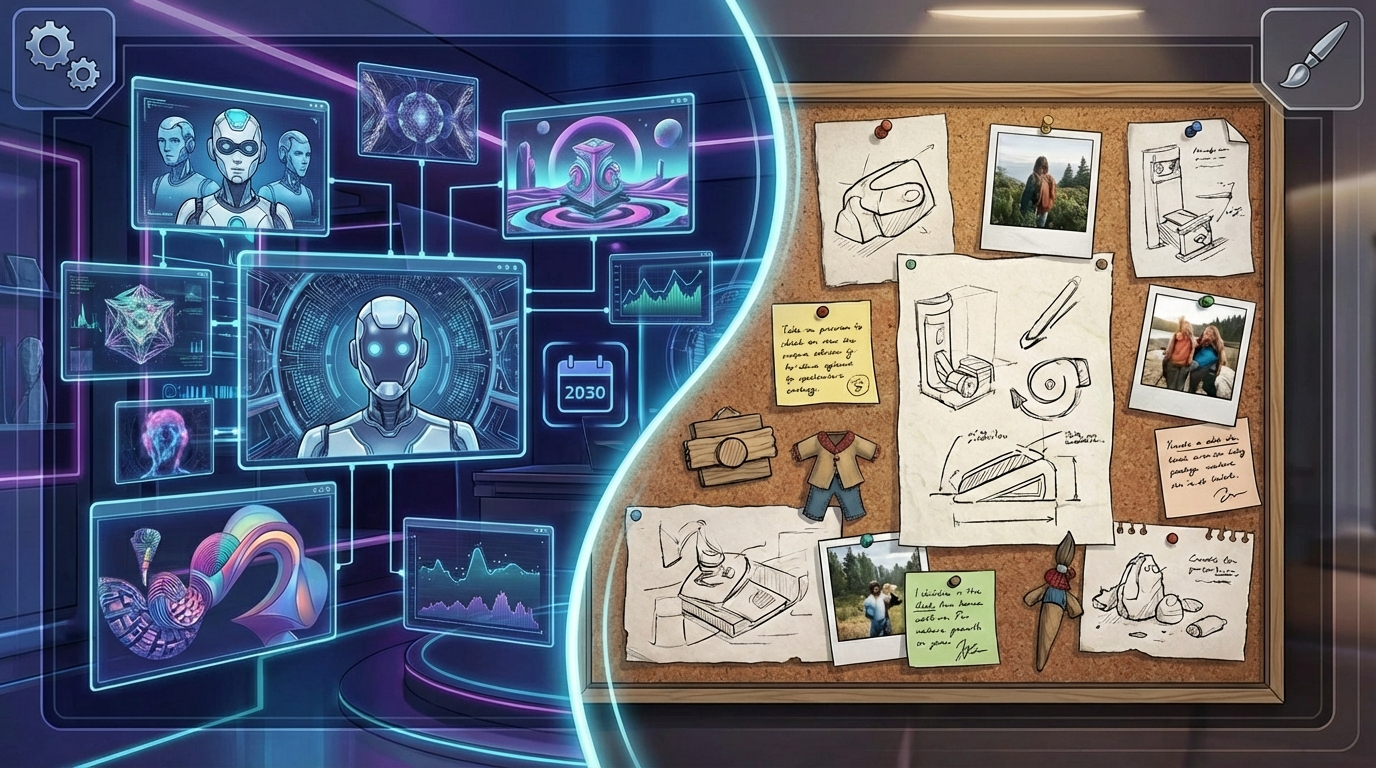
By 2030, Over Half of Social Content Will Be Made With AI
| 3 minutes read
And Most of It Will Be Forgettable
By 2030, more than 50% of social content will be made with AI. The number itself isn’t shocking anymore. What’s surprising is how calmly it’s repeated, as if volume were the achievement. History suggests otherwise. More content rarely leads to more impact. It usually leads to more noise, faster saturation, and shorter memory.
AI has removed friction from creation. Posts can be written instantly, images generated endlessly, videos produced at scale. The barrier to entry has collapsed. But while creation has become easier, meaning has become scarcer. When everyone can publish, the advantage shifts from who can make content to who knows what’s worth saying. This is the same inflection point businesses hit when tools move faster than judgment, a pattern explored in why tools alone don’t create advantage.
As AI-generated content becomes the default, social platforms will quietly split into two worlds. One will be filled with content optimized for frequency, trends, and algorithms. The other will be shaped by point of view, lived experience, and intent. The first will dominate volume. The second will dominate memory. This is the same divide already visible in businesses that rely on automation to keep up versus those that use systems to express what they already understand, a contrast echoed in the real advantage isn’t AI.
Most AI content will blend together because AI is excellent at averaging. It produces what looks right, sounds acceptable, and feels familiar. But familiarity doesn’t build trust. It builds indifference. As more brands publish AI-generated content without clear direction, feeds will fill with messages that are technically correct and emotionally empty. The content won’t be bad. It will be invisible. This is what happens when consistency is mistaken for clarity, a problem often surfaced in why confidence comes from alignment, not repetition.
The businesses that stand out won’t be the ones using AI the most. They’ll be the ones using it with constraint. They’ll know what they don’t want to say, what they repeat on purpose, what tone they never break, and which ideas they return to over time. AI will help them scale expression, not invent it. This mirrors what we see in teams that grow without losing their voice, a dynamic reflected in how businesses work smarter instead of louder.
By 2030, social content won’t feel like campaigns anymore. It will feel like infrastructure. Recurring formats, recognizable framing, consistent points of view. AI will power the machinery, but direction will decide the output. This is the same transition that happens when newsletters, demos, or communities stop being experiments and start becoming dependable systems, something explored in building a newsletter people actually share.
AI doesn’t flatten creativity. It exposes the lack of it. When generation is easy, the hard part becomes knowing what matters, what to ignore, and when to stop. That’s why businesses that already understand their customers will pull further ahead, while those chasing trends will struggle to differentiate. The pattern is familiar, and it’s the same one outlined in still using a calculator when systems already exist.
By 2030, the question won’t be whether you use AI. Everyone will. The real question will be whether you know what you’re trying to say. AI will happily help you say anything. It will not help you decide what’s worth saying. That decision stays human, and the businesses that treat AI as a way to amplify intent rather than replace it will be the ones people still recognize, remember, and trust.